
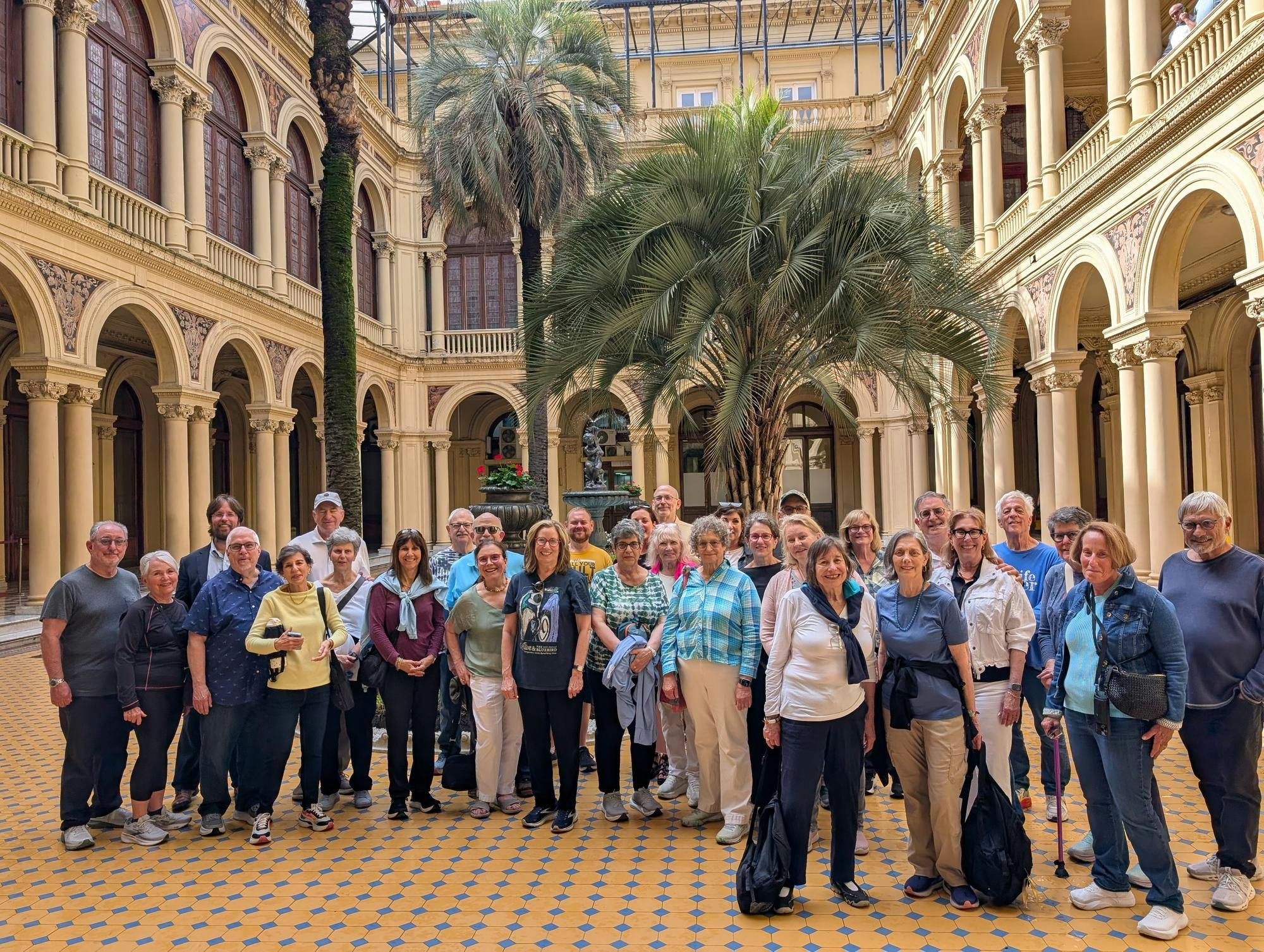
This spring 30 people, led by Rabbi Joshua Kullock of West End Synagogue, journeyed to Argentina. From the sprawling, bustling capital city of Buenos Aires to the majesty of Iguazu Falls National Park, the group experienced the sights, sounds, and culture of Rabbi Kullock’s native country.
The trip began with several days in Buenos Aires, a complex city patterned after the great European cities of Paris and Rome, but with the urban beat of New York City’s Manhattan. Thanks to knowledgeable guide and native Argentine, Alex del Aguila, the group learned about the country’s origins as a land of immigrants, mostly from Italy and Spain.
The first few days were filled with visits to both Jewish and civic historic sites. Among the highlights was a visit to the grand Palacio Bosch, home of the American ambassador to Argentina. The home is an example of the grandeur of many historic homes in Buenos Aires. The ambassador was not available as he was traveling to Israel, but the group met with one of the ambassador’s political advisors. During the meeting the group discussed an array of topics from day-to-day operations of the embassy to ways the ambassador is helping to address antisemitism in Argentina.
Another highlight was a briefing with Claudio Epelman, executive director of the Latin American Jewish Congress. Epelman, along with other local Jewish leaders, shared information about the demographics of the Latin American Jewish community and answered questions about Jewish life, antisemitism, and other issues.
There was also a visit to AMIA, Argentine Israelite Mutual Association, an organization similar to Jewish Federation. The current building sits on the site of a 1994 terrorist bomb that killed 85 people and wounded hundreds more. The organization continues to recover and rebuild in the wake of that traumatic incident, which also followed the bombing of the Israeli embassy two years before.
The group also visited the oldest synagogue in Buenos Aires, and enjoyed Shabbat services and dinner at Congregación Amijai. During the musical service, member of Nashville’s Jewish community joined with the local Jewish community in prayer, singing, and dancing in celebration of Shabbat.
Other cultural sites visited included the Teatro Colon, one of the world’s most renowned opera houses, and the Palacio Rosado, the Pink House where the Argentinian President works. Both buildings are examples of Argentina’s art and architecture that is influenced by its European roots.
The group winged its way two hours north to the Iguazu Falls National Park. The park borders Brazil, and the visit began there to experience a panoramic view of the largest waterfall system in the world, followed on the second day by entering the Argentinian side. It was there that visitors could get a close-up view, very close up for those who boarded a boat that took them right under a section of the falls.
The return to Buenos Aires coincided with Yom Ha’atzmaut and a seat in one of the Broadway district’s large theaters for an evening of dance, songs, and celebrations in honor of Irael’s independence.
The nearly two-week sojourn was exciting, intense, exhausting, and memorable. Below are some reflections from participants, including Rabbi Kullock.
Rabbi Joshua Kullock:
The Jewish Observer is published by The Jewish Federation of Greater Nashville and made possible by funds raised in the Jewish Federation Annual Campaign. Become a supporter today.
I’ve been thinking a great deal about our time together in Argentina, and I want to thank each of you for making it such a meaningful, joyful, and memorable journey.
From the streets of Buenos Aires to the breathtaking beauty of Iguazú, what made the trip truly special was not only where we went, but how we traveled together. Your good spirits, your curiosity, and your willingness to explore, learn, and engage—with the images, the flavors, and the distinctive character of my hometown—meant more to me than I can fully express. You were troopers in every sense, and it was a privilege to share that experience with you.
Marsha Jaffa:
One of the interesting things about Argentina is finding out that they are as actively Jewish as we are. From going to The Latin American Jewish Congress, AMIA (Asociación Mutual Israelita Argentina) to The Israeli Independence Day Celebration where 3,500 people attended with such love of Israel was very endearing. At The Latin American Jewish Congress, we got a deeper insight about how they serve Argentina and the world. There was a great conversation on antisemitism and social media. When Israelis were murdered and captured by Hamas on October 7th, Hamas was ready to come out with antisemitic remarks about Israel and were ready to rally our college students.
We visited Temple Libertad, the oldest Jewish synagogue in Bueno Aires. It was built in 1932 and renovated in 1987. We heard about the history of the synagogue and took an interesting tour of the museum. My favorite artwork was a mixed media piece of the menorah.
We also visited the Latin American Jewish Congress. We got a deeper insight about how they serve Argentinian and the world.
We also went to AMIA, Association Mutual Israelita Argentina. Its mission is to improve life for young and old Jewish people. They are working for a better life for Argentina Jews. They work for inclusiveness and pluralism. They were bombed in 1994 and have been rebuilt. My favorite Jewish Artist is Agam who does kinetic and optical art. It was nice seeing his art there. He has a museum in Israel in Rishon LeZion.
Lorna Graff:
“ So….guys “- and that was the way we started each morning with our incredible guide, Alex. Rabbi Kullock did an amazing job with his many “connections.” We saw special sights and learned a great deal about the history of Argentina. Rabbi made sure we had a great time, behaved ourselves and added to our understanding of his “homeland.”
Janet Weismark:
There are three meaningful holidays in the spring that we commemorate and celebrate. These three enriched our trip to Argentina and made it more than just another vacation. Our trip began on a somber note with a visit to the holocaust memorial in Buenos Aires where Rabbi Kullock lit a memorial candle and talked about the loss of six million of our brethren.
On Yom Hazikaron we visited the site of the Israeli Embassy that was bombed in 1992 in which 29 people died and 242 were wounded. Rabbi addressed the loss of those who have lost their lives in bombings and terrorism and the young Israeli soldiers who have given their lives in the many wars that have been fought since 1948. Rabbi so beautifully sang El Malei Rachamim and we recited the mourner’s Kaddish and sang Hatikvah.
The highlight of the trip was celebrating Yom Ha’atzmaut with 3200 Argentinians. A program replete with choreographed Israeli songs and dances entertained us for two hours. The crowd sang their national anthem with fervor followed by an emotional Hatikvah. The ruach and excitement in the room was palpable. The pride we felt in our Jewish homeland was exhilarating.
Travelling with Rabbi Kullock to his birthplace and being able to share meaningful Jewish moments was an experience we will carry with us for many years to come.
Barry Allen:
Going to Argentina was not on Heidi’s or my bucket list. However, at least three things convinced us that we should go. One, we knew almost everyone who was planning to attend. Second, we appreciated that having a native of Buenos Aires and our rabbi as the tour leader was a special opportunity. Lastly, we heard that dulce de leche and the gelato were not to be missed. The trip exceeded our expectations.
Everyone got along beautifully, and we got to spend quality time with people we didn’t always see outside of services or at a synagogue event. Our professional guide was exceptional, yet having Rabbi Kullock add his own personal knowledge and experience - including food recommendations and his unwavering, enthusiastic support for the River Plate soccer team - did add significantly to what we learned about the history and culture of the city and country. And yes, the dulce de leche chocolate covered alfajores (“cookies”) and the gelato lived up to the hype.
Ruth Liebowitz:
One of the most unforgettable moments of the trip occurred during the Yom Ha’atzmaut celebration at the famed Gran Rex Theatre in Buenos Aires. The event, organized by the Argentine Zionist Organization, drew hundreds from the local Jewish community. Rabbi Kullock somehow managed to secure coveted tickets for our entire group.
The atmosphere inside the theater was electric. Nearly 600 people filled the auditorium with Israeli flags, music, cheering, and celebration. The performances of music and dance radiated joy and pride, creating a powerful expression of Jewish identity and Zionism. As Rabbi Kullock had written to us, it is “a meaningful and vibrant atmosphere celebrating heritage, identity, and unity.”
We experienced a variety of memorable activities. One evening introduced us to Argentina’s signature cultural art form: the tango. At a lively nightclub performance, the elegance and intensity of the dancers captivated us. Rabbi Kullock also arranged extraordinary access for our group, including private visits inside the iconic Casa Rosada, Argentina’s presidential palace, and the American Embassy—locations even our guide could not enter with us. We attended a moving musical Shabbat service in a remarkable partially open-air synagogue.
The trip also exposed us to some of Argentina’s darkest history. During the brutal military dictatorship from 1976 to 1983, approximately 30,000 people disappeared during what became known as the “Dirty War.”
Reading about historical events from afar can never compare to actually being where they occurred. Buenos Aires endured devastating acts of antisemitic terrorism when the Israeli Embassy was bombed in 1992, followed by the 1994 bombing of the Asociación Mutual Israelita Argentina (AMIA) building. The AMIA attack, carried out with a suicide car bomb, killed 85 people and injured more than 300, making it the deadliest terrorist attack in Argentina’s history. Visiting both memorial sites and hearing firsthand accounts from local residents was deeply moving.
Buenos Aires is often called the “Paris of South America,” and it is easy to understand why. The city is cosmopolitan, elegant, and remarkably clean. Argentine flags—three horizontal stripes of blue, white, and blue with a golden sun at the center—appear proudly throughout the city. Tree-lined boulevards, landscaped parks, historic neighborhoods, and magnificent architecture give Buenos Aires a distinctive charm. We visited an opulent opera house and an enormous bookstore that seemed almost cathedral-like in scale. The older neighborhoods especially fascinated me; I would gladly spend days wandering and lingering there.
Buenos Aires held many surprises for me. It is a sophisticated, vibrant city unlike any other Latin American destination I have visited, and I have traveled extensively throughout the region. This journey not only deepened my appreciation for Argentina and its Jewish community but also left me eager to return.