
The new year began with an ice storm that swept through Nashville bringing with it downed trees, burst pipes, and prolonged power outages. The event marked the first of its kind in 40 years, came during the coldest days of the season, and sent thousands fleeing to hotels and community warming centers. Nashville’s Jewish community, led by Jewish Family Service, sprang into action assessing the needs and providing assistance. According to Toni Jacobsen, clinical director for JFS, unlike previous disasters, this time the struggles hit close to home. “This is the first time this was our emergency, too,” she says, “We had to put the oxygen mask on ourselves first because we didn’t know if the power would be back in eight hours or longer.”
Once it became apparent the situation would continue for a while, and with temperatures dropping, JFS mobilized its staff and network of volunteers. “When we realized this would be more long term, we knew what to do. And what we did first was call the seniors who didn’t live in a facility, that lived at home, had no family, and then just kept broadening out from that.”
As the temperature dropped, Jacobsen her team identified who was in distress and needed a place to stay. The challenge, she says, was needs kept evolving. “What we found was some people who said they were fine, were not fine a few days later. Their situation changed.” Her team helped find hotel stays for people who could not otherwise afford it. “For those who needed it, it was lifesaving,” she says.
Some of the hotels did not provide meals, which also necessitated problem solving. Jacobsen said. In addition to sending snacks and other items through Shipt, JFS partnered with The Temple, and Sherith Israel, and the JFS board to ensure everyone had at least one hot meal a day.
Jacobsen said one of the challenges was the wholesale loss of power, meaning the volunteer pool was smaller than usual. At The Temple, Rabbi Michael Shulman, says he was one of the lucky ones who had power along with a couple of others. “We were trying to be the point people because all of the other staff of The Temple, the clergy were all affected.” Rabbi Shulman contacted as many people as possible, using his own cell phone, to find volunteers and about a dozen answered the call.
The Temple’s group coordinated with Jacobsen, collecting food, snacks, clothes, toiletries, and arranging transportation and made deliveries to those staying in hotels. “It was good because we were itching to do something and wanted to help in any way we could.”
Shulman says it was gratifying to see people coming together to help each other. He says in one instance, the older children of a couple who was out of town braved the icy roads. “They went to Target to shop for some things for someone who was displaced and who basically left without anything. They delivered to someone they don’t even know.”
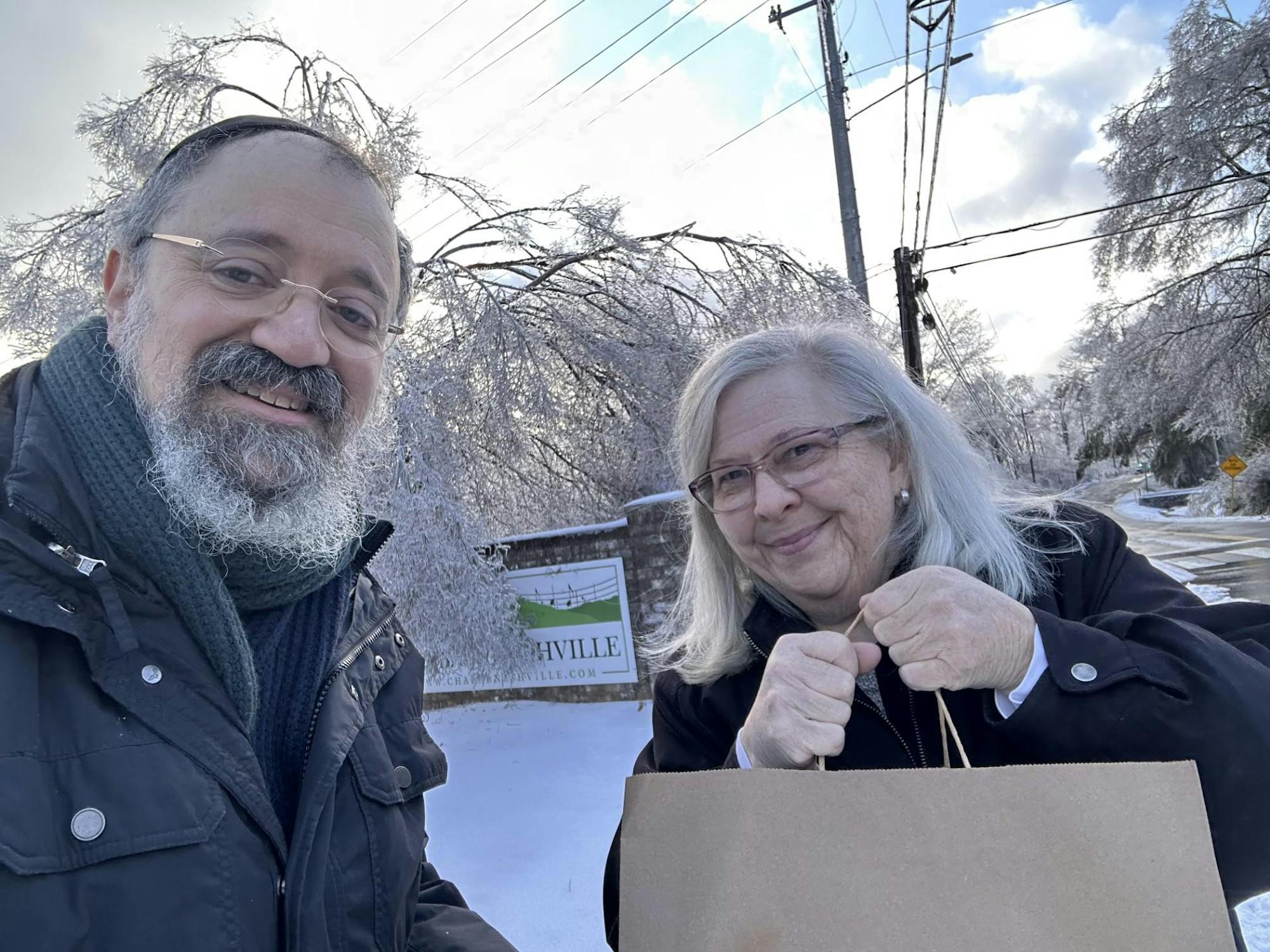
Down the road, Sherith Israel’s power returned quickly, and Rabbi Saul Strosberg welcomed people in for meals, a place to charge devices, to sleep, and in some instances, to shower in the synagogue’s Mikvah. “Close to 30 people slept at the shul that week,” says Strosberg who was himself without power at his home, “There were a lot of families and people came and cooked. You’ve heard of too many chefs in the kitchen, we had every chef.”
Strosberg created a sort of resort atmosphere, complete with a ping pong table, movie nights, and slumber parties. And they also answered Jacobsen’s call for help. “Toni called and gave us the opportunity to send some meals to people in hotels.”
In the midst of all the activity, Strosberg says a highlight was Friday night Shabbat dinner. “That was beautiful on Friday watching all the different parents and children,” he says. And one guest brought a surprise. “We had one person from Long Island who either really wanted to get out of Long Island or wanted to feel like he was helping. He flew out here and brought his starter dough and on Friday took some of the kids and made these beautiful sourdoughs for Shabbat.”
The children made the most of the situation in what became a camp of sorts, with at least one surprising result. “The boys slept together and we had movie nights. One night a family got their power back and the son begged to keep staying at the shul with the other kids. And there was another family with teenagers and when they got power back, the teens wanted to keep sleeping at the shul so they came back and joined the group.”
The Jewish Observer is published by The Jewish Federation of Greater Nashville and made possible by funds raised in the Jewish Federation Annual Campaign. Become a supporter today.
Not every moment was fun filled, though. Strosberg says, “There was one mother with three little ones crying on another woman’s shoulder because she was so stressed.”
The stories of warmth and community continued at Chabad of Nashville in Bellevue, which stayed powered up thanks to a generator. According to Rabbi Itzchok Tiechtel, a senior couple shared that they had been sitting in their home since Sunday morning, more than two and a half days, without power, heat, or light. They lived by candlelight, wrapped in layers, enduring the cold in silence. When a volunteer from Chabad knocked on their door with a hot meal and genuine concern, they were overcome with emotion. They later shared that they had tears in their eyes. Not only because of the food, but because when so few people were able to be on the roads, someone came for them. They felt seen. They felt loved. They felt they were not alone.
And in one instance, even visitors to Nashville felt the need to reach out. A businessman traveling to Nashville for work suddenly found himself stranded by the storm, unable to return home to his family. For days, he was confined to a hotel room as roads shut down and even food delivery services stopped operating. Hungry, isolated, and far from home, he did not know how he would manage. When Chabad of Nashville learned of his situation, a volunteer brought him meals to his hotel.
“In moments like these, leadership means showing up, with heart and soul” said Rabbi Yitzchok Tiechtel, Director of Chabad of Nashville. “Every person is created with purpose and worth. Our responsibility is to care for each individual with love and warmth, especially when people feel afraid or forgotten. No one should ever feel alone.”
Even as the ice melted, people are still in need. Jacobsen says after focusing on survival and getting people settled back home, the crisis had evolved. “We’ve had at least two families who lived in apartments and water pipes broke and they lost everything.” She says there are those who need help replacing their food, as well.
All of those who volunteered, provided warm shelter, food, and companionship, say it was gratifying to see the community come together to help each other. Shulman says, “This is why we’re a community it’s allowing us to help.” And Strosberg says while some people remained in their homes, it was important for people to know they were not alone. “There is a tendency to just run away and shelter by yourself, and there’s the other tendency to run to the community.”