
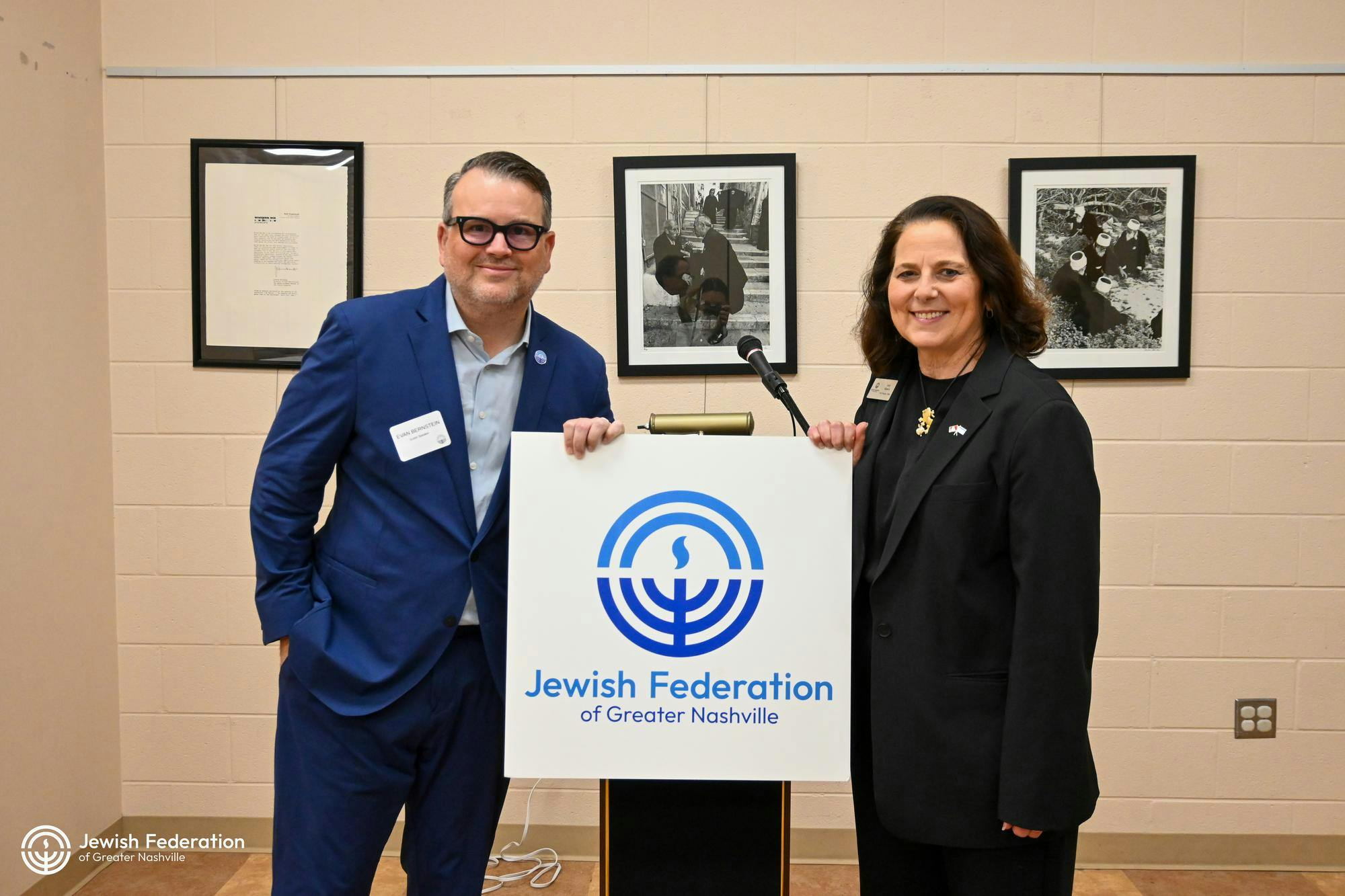
It is an often-repeated statistic: antisemitism is making a steady climb upwards, last year reaching 9,354 incidents nationally as reported by the Anti-Defamation League. This number represents a 344% increase over the last five years. And the subject topped the agenda when Evan Bernstein, vice president of community relations for Jewish Federations of North America (JFNA) met with the local Jewish community recently. “We’re looking at the normalization of antisemitism and hate crimes,” he said, “We’ve moved from anti-Israel to antisemitism.”
Bernstein first met with members of the local Jewish Community Relations Committee. He walked them through a SWOT analysis, an exercise that looks at strengths, weaknesses, opportunities, and threats. JCRC co-chair Arthur Perlen says, “It was very helpful for the JCRC for the future to start thinking about goals and mission. He posed questions that helped us think that through.”
JCRC vice chair Erin Coleman says she was pleased to work through the analysis because it highlighted some important areas. “Having him here helped us have the difficult conversations we needed to have, or start to have.” She says specific issues include broadening the scope and reach of the JCRC. “It’s not just looking at diversity from a political standpoint or religious, but we need to diversify in terms of the age of who is on the committee and who is coming forward and who is participating.”
Bernstein described various forms that antisemitism takes in today’s world. He cited antisemitism in the healthcare world, which shows itself both among medical professionals, and patients who refuse to work with Jewish doctors. One attendee who is a licensed clinical social worker reported patients expressing increased due to their encounters with antisemitism in their work places.
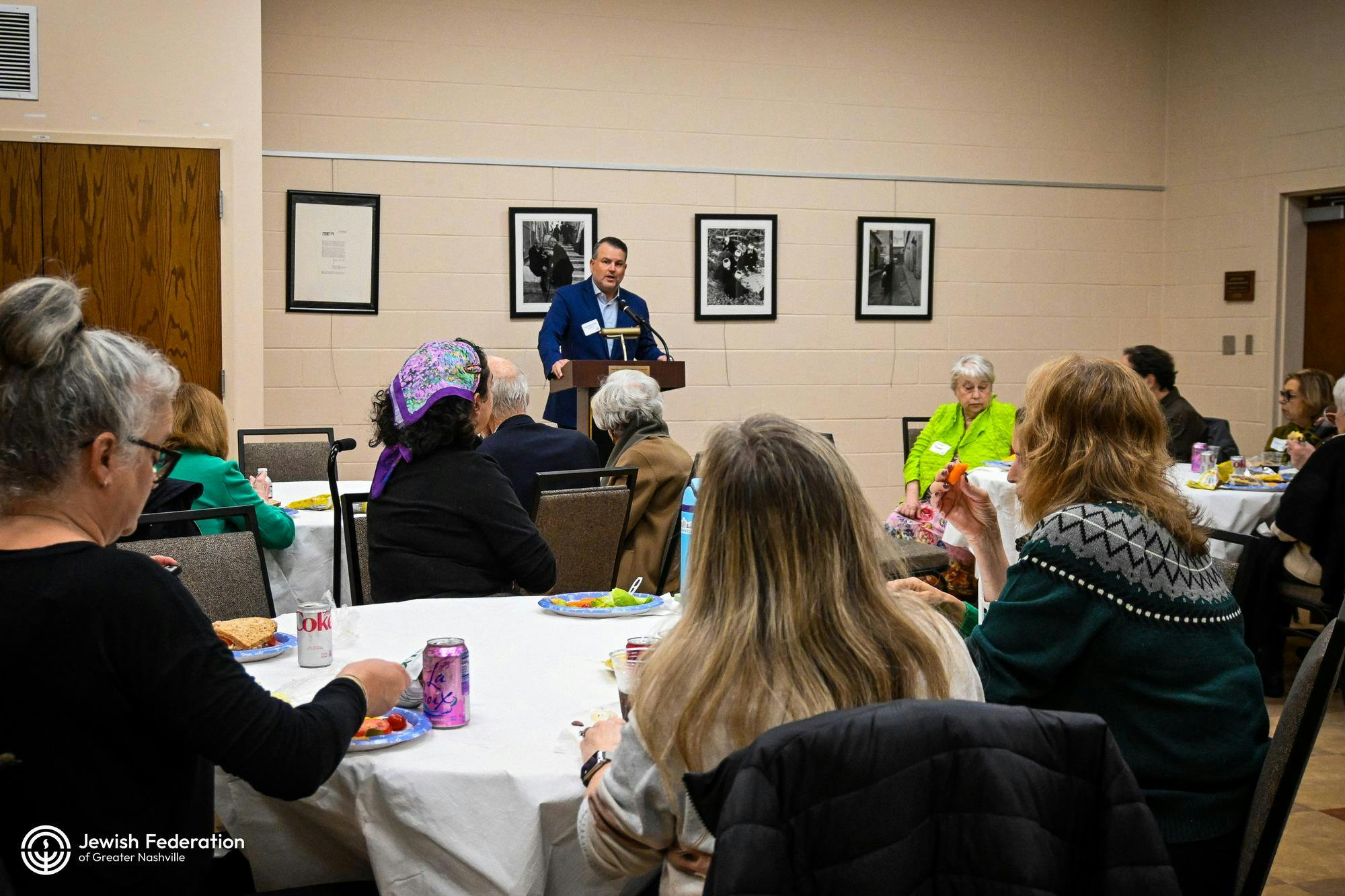
Felicia Anchor, chair of the Nashville Holocaust Memorial was in attendance. She asked, “What are relationships that are being built to help combat this antisemitism?” Bernstein described a community wide mapping initiative. The process involves working with 12 to 15 community volunteers and actually mapping out areas in the community, determine who the key people are with whom to build relationships and then assign volunteers to go out and steward those relationships. “Through this process, we can get information about the right people and most impactful leaders.”
Others at the event expressed the need for tackling difficult issues in a more personal way. Judy Saks said, “Individual conversations mean a lot. It makes it easier to bring up hard topics.” And when community member Teena Cohen heard about antisemitism in local schools, she leveraged her relationship with her local state representative. “I called my representative and asked him to talk to the school superintendent.”
Questions arose about criticism of Israel. Irwin Venick, a member of the Nashville Jewish Social Justice Round Table, asked, “What is the space for criticizing Israel without it being considered antisemitism?” Bernstein said there is a line that should not be crossed. “There is a place for criticizing Israel but not denying Israel the right to exist. It’s important to maintain that context.”
After the community event, Bernstein sat down with The Observer to talk more about Israel and antisemitism in today’s world. A question arose about how to bridge a generational divide when talking about Israel. “I think you have to have a baseline,” said Bernstein, “The baseline is Israel has a right to exist as a Jewish state, and then everyone can have commentary around that.” He said sometimes there is a loss of nuance, leaving out room to be critical but still acknowledging Israel’s existence.
When it comes to engaging in dialogue about Israel, Bernstein says it is often hard to feel knowledgeable. “We have to pivot ourselves to become more comfortable with the current state of social media and how people are learning and getting information.” He said it is important to maintain context and that framing is critical.
For an organization like Jewish Federations, the challenge is to be able to meet people where they are and also address the diversity in communities. “There’s a way to do it, it’s not going to be popular because it’s a change for Federations. It’s to address the issue, reframe it and then message that.” He adds it is time to focus more of the work on domestic issues facing the Jewish population.
The Jewish Observer is published by The Jewish Federation of Greater Nashville and made possible by funds raised in the Jewish Federation Annual Campaign. Become a supporter today.
Turning to the role of Federation in today’s climate, Bernstein says it is important that it maintain itself as the central address of the Jewish community. “There’s no other Jewish entity that has the breadth and depth of the system, which makes it one of the most powerful things in the Jewish community. One of the things that keeps the Federation above board is being distinctly down the middle. As Abe Foxman told me, you get hit on both sides of traffic when you’re down the middle which means you’re doing something right.”
Bernstein says that while some communities have a majority that leans in one direction, it boils down to leadership to determine the messaging. “Some of it is a business decision, some of it is the nature of the community, some of it is the leadership that is involved.” He adds that for JFNA, leadership definitely has the vision for the direction of the organization. And he believes when Federations take a middle ground it is easier to have private, more nuanced conversations with those on either side.
The conversation turned to the topic of mission trips, particularly to Israel. Despite a growing divide within the Jewish community, Bernstein believes these types of experiences remain relevant and important. “People going to see Israel is a major play in how people will understand. Because right now their definitions are built in periodicals. When they see a country that is diverse, that has LGBTQ rights, has rights for minorities, has rights for Arabs that are staying in Israel and don’t want to leave, you have Jews that are as reform or agnostic as they are Chasidic, all living in one place. When they see that physically it blows their mind because of what they thought it would be from the media.”
Bernstein’s visit to Nashville was initiated by Jewish Federation of Greater Nashville CEO Judy Alperin, who is hoping to participate in the mapping project. She says, “We have a very strong, vital Jewish community here that is looking to continue building on relationships we have with our friends, neighbors, and allies. This initiative will provide us with the necessary tools to move forward toward that goal.”